
A very unexpected interview


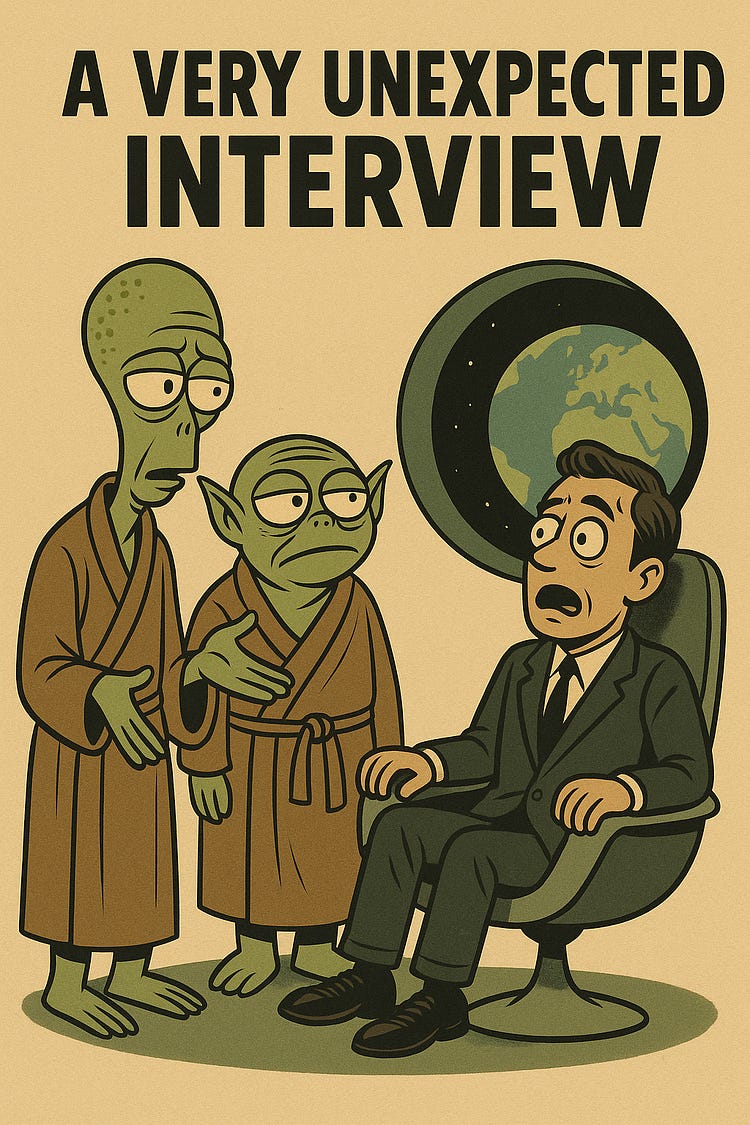
Here we are again, adrift in the silent, star-dusted ink between worlds. Your humble narrator, tagging along for the ride. The Jacksons’ research vessel, a marvel of seamless, featureless grey, hums with the low thrum of profound thought. Or perhaps it is just the life support. With these folks, it is often hard to tell the difference. They are on their way back from the general vicinity of Earth, having poked the Terran anthill and been rather startled by the frantic scurrying that ensued.
Now, our diligent grey philosophers are doing what they do best. They are processing data. Oceans of it. They possess the unique ability to travel not just through spaceat the speed of light. Their ship’s sensors can peel back the years, watching civilizations flicker and bloom like time-lapse fungi. They are rewinding the tape on humanity, seeking the origin point of the current, spectacular dysfunction. They want to understand when the rot set in. When a species with a perfectly serviceable planet decided to turn it into a combination landlord dispute and garbage fire.
They had assumed the mess was an ancient, ingrained trait. A slow, steady decline into illogical chaos. The data, however, was beginning to suggest something else entirely. Something sharper. Something more recent. Something that felt less like evolution and more like an intervention.
Inside the vessel’s central observation chamber, the light was a cool, analytical blue. Holographic charts pulsed in the air, depicting two millennia of human societal development. Babi Jackson, her focus a tangible force in the room, pointed a slender, three-fingered hand at a cascading graph. Gary Jackson stood beside her, his posture one of quiet, academic confirmation. Brew, naturally, was orbiting them slowly, his robes drifting in the microgravity as he absorbed the information with a theatrical intensity.
“The pattern is unmistakable,” Gary began, his telepathic voice as dry as powdered moon rock. “For approximately nineteen hundred of their years, Terran token systems were chaotic yet diverse. They had multiple layers of exchange. A farmer might trade grain for a blacksmith’s tools. A community might collectively owe service to a neighboring one. Tokens, where they existed, were one of many lubricants for their societal engine.”
The graph shifted, showing thousands of localized systems, messy and inefficient, yet resilient.
“Then,” Gary continued, tapping the display, “we observe a consolidation event. It occurred with baffling speed over the last century of their time. The multiple layers of value collapsed. Everything became subordinate to a single, abstract token stream. The goal shifted from the exchange of goods and services to the pure accumulation of tokens.”
Babi’s thoughts cut through the silence, sharp and precise. “It is more than a consolidation, Gary. It is the installation of a secondary incentive structure. A parasitic code layered over their primary motivations.”
Brew stopped his slow orbit, his interest piqued.
Babi projected a new model. “Consider a Terran with specialized knowledge. For instance, an individual who understands how to treat a common cognitive variation, one they label ‘neurodivergence’. In the older, multi-layered system, that individual’s purpose would be the direct application of their knowledge to improve the well being of others in their community. The reward would be reciprocal service, status, or simple sustenance.”
“Now,” she altered the model, and a glowing, golden layer appeared over the simple exchange, “the token system intervenes. The specialist’s primary goal is no longer to help. The goal is to acquire tokens. The helping becomes the means to that end. This corrupts the entire process. The specialist has an incentive to make their knowledge seem complex, arcane, and essential. They are motivated to create dependency.”
Her model showed a suffering Terran approaching the specialist. The specialist, instead of offering a complete solution, provides a small, temporary improvement. A single step in a long, monetized program.
“The specialist does not want to solve the problem,” Babi stated. “A solved problem generates no more tokens. They want to manage the problem indefinitely. They create a loop. They simplify the issue into easily digestible doses of improvement, keeping the other Terran returning, paying for each new, incremental piece of a puzzle that is never meant to be completed. The specialist’s value is no longer in their knowledge. Their value is in their engineered necessity.”
“We observed this pattern repeatedly,” she continued, her thoughts now pulling from their more recent groundwork. “Their device-based information network is saturated with it. Terrans with all manner of conditions, from toxin addictions to these cognitive variations, are targeted. They are taught to see themselves as broken machines requiring a licensed mechanic. And the mechanics have no interest in teaching them how to fix themselves. They want to be the only ones who can sell the spare parts.”
Brew floated closer, his multifaceted eyes wide with a dawning, terrible excitement. “So their entire system of care is a marketplace. A beautiful, elegant, horrifying marketplace.”
“It is the second layer,” Babi affirmed. “It infects everything. Their global enterprises do not build housing to shelter people. They acquire housing to create a perpetual stream of rental tokens. They do not share technology to feed the hungry. They create automated, multi-step courses to sell the idea of the technology. Their systems are no longer designed to solve problems. They are designed to commodify the state of having problems.”
She gestured to another data point, a flicker of information about Terran research practices. “It even dictates how they study themselves. Their research into these conditions focuses on participants who fit a narrow, convenient profile. Those who can communicate in standard ways, who can tolerate the sterile testing environments. They create a ‘zone of the researchable’, then build their entire understanding of a condition based on this biased sample. They exclude those with the highest support needs because they are difficult to measure. Then, they are surprised when their one-size-fits-all solutions fail the very people who need them most.”
Gary nodded grimly. “The system perpetuates its own ignorance for efficiency’s sake.”
There was a long silence, filled only by the quiet hum of the ship. The Jacksons contemplated a species that had turned the act of helping into a subscription service.
Then Brew spoke, his thoughts a supernova of speculation. “This is not a natural development.”
Gary and Babi turned to him.
“No,” Brew insisted, his voice resonating with newfound conviction. He began to pace the air, his movements becoming more agitated. “A species does not accidentally create a system so perfectly, so universally parasitic. Evolution is messy. It leaves artifacts, redundant systems, inefficiencies. This… this is clean. It is a single, elegant piece of code that overrides every other social function with a simple command: ‘acquire tokens’.”
He gestured wildly at the holographic timeline. “Look at Gary’s data. Nineteen hundred years of chaotic, diverse, organic systems. Then one century of a total, global rewrite. It is too fast. It is too comprehensive. It is not the work of a species fumbling its way through development.”
He stopped and faced them, his form radiating a powerful idea. “We have been looking at this all wrong. We debated the ‘cosmic glitch’. We theorized that humans were a flawed AI. We were thinking of it as a bug, an error in their programming.”
He paused for dramatic effect.
“It is not a bug,” Brew declared. “It is a feature. It is not an error. It is an installation. Someone, or something, hacked their planet.”
The weight of the idea settled in the chamber. It was audacious. It was unprovable. It was, for a Jackson, dangerously close to a leap of faith. It was also the first theory that accounted for all the baffling data.
Babi was the first to process the implication. “An external intelligence,” she thought, her analytical mind racing. “An intelligence that found humanity’s diverse, multi-layered societies too unpredictable. So they introduced a unifying protocol. A simple, universal operating system based on a single, quantifiable value. Tokens. It would make the entire species predictable. Controllable.”
“It would make them easier to manage,” Gary added, his pragmatic mind seeing the cold logic. “Or easier to harvest.”
Brew snapped his fingers, the sound a strange, sharp pop in the telepathic quiet. “Precisely! We have been debating the ethics of eating these perplexing creatures, wondering if we are consuming a flawed but natural life form. What if we are merely interfering with another civilization’s farm? What if their rampant reproduction, their environmental destruction, their self-commodification, are all intended outcomes? What if they have been deliberately corralled into this state of frantic, token-obsessed despair?”
The three of them stared at the image of the blue and white planet hanging in the void. It no longer looked like a world of chaotic, self-destructive beings. It looked like a terrarium. An experiment. A neatly managed, if rather cruel, long-term project. The question was no longer whether the Jacksons should eat the humans. The question was, who owned the menu?
A fresh energy pulsed from Brew, a kinetic hum that vibrated through the chamber’s calm. The grand theory was not enough. A theory was a beautiful, sterile thing. Brew preferred applied science. He preferred action.
“So,” he announced, his thoughts bursting forth, “we have a practical proposal. A way forward. Forget harvesting. Not for now.”
He made a mental note to send a message to Grag, who would surely find this new direction a great relief. The precautionary principle, in all its cautious glory, was being rigorously applied.
“We will have a conversation,” Brew declared, as if he had just invented the concept. “Exactly, folks. A simple talk. Be it a cosmic AI, be it another species running a planetary-scale farming operation, whatever it is, we have to investigate. We need to understand the command structure. Something is fundamentally wrong down there, and the answer is not in mass observation. The answer is in targeted interrogation.”
He projected holographic images of Earth’s most prominent token-hoarders. The faces were familiar to the Jacksons from their surveillance. There was the one who built rockets and the one who had connected a billion Terrans through a device-based social network before selling their attention spans for tokens.
“These individuals,” Brew explained, his excitement making the images shimmer, “these ‘wealthy’. They possess a ridiculous, illogical amount of control over their planet’s resources. If an external intelligence is managing Earth, these are their agents. They must be. It is the only explanation for such concentrated power. They are the viceroys of the unseen emperor.”
His plan took shape in the air between them. “We will abduct five of them. The richest. The most influential. Elon Musk. Mark Zuckerberg. We bring them here, to a neutral, comfortable environment. We will be polite. We will be direct. And we will ask them a very simple question: Who are you reporting to?”
Babi processed the proposal. Her own analysis of the parasitic token system aligned perfectly with this course of action. These individuals were the nodes through which the entire corrupting code was administered. To study them was to study the source code itself.
“The proposal is logical,” her thought-form stated, crisp and devoid of emotion. “It isolates the primary anomaly. The highest concentrations of token control represent the point of maximum systemic leverage. Direct interrogation is the most efficient method for data acquisition. I will be present to monitor their physiological and psychological responses to questioning.”
Gary’s agreement followed, measured and academic. “Understanding their justification for resource accumulation is the central question. The mechanics of their command structure are critical. If they are agents, their operational protocols would be invaluable data. I must also be present.”
A small, triumphant flicker came from Brew. “Excellent. It is a scientific mission, then. And should it happen that the entity controlling them has some complaints about us removing its key personnel from the board… well. That would be an excellent opportunity for a second conversation, would it not?”
And so it was decided. Not in a grand council chamber with gavels and robes of judgment, but in the sterile blue light of a research vessel, by three inquisitive minds who had stumbled upon the most fascinating puzzle in the galaxy. They had a plan. They had their targets. The universe’s most aggressive and invasive existential audit was about to commence.
Your humble narrator can hardly contain his delight.
Oh, the sheer, delicious irony of it all. Imagine the scene. On Earth, a man like Elon Musk wakes up. He checks his token value, which has likely increased by several nations’ GDPs while he slept. He sips his nutrient-optimized beverage. He contemplates the logistics of populating Mars, a grand endeavor to ensure the survival of his species. He sees himself as a titan, a visionary, a protagonist pushing humanity’s narrative forward. He is, in his own mind, the hero of the story.
Little does he know, he is about to be subpoenaed by the cosmic HR department.
He is utterly unaware that several light years away, three curious grey beings have scheduled him for a performance review he did not know he was subject to. They are not interested in his vision for Mars. They are not impressed by his rockets. They see his vast accumulation of tokens not as a sign of success, but as a symptom of a planetary infection. They see him less as a titan and more as a particularly interesting microbe to be placed under a microscope.
The Jacksons are proceeding with a clinical precision that is both admirable and terrifying. They are preparing their ‘interview suite’. They are calibrating their telepathic translators to account for human ego, a variable they have found to be surprisingly dense. They are drafting their questions, not with the intent to intimidate, but with the genuine, unnerving curiosity of a biologist asking a beetle why it insists on rolling its little ball of dung in a particular direction.
“Please justify the perpetual accumulation of resources far exceeding your biological needs.”
“Describe the emotional feedback loop associated with observing your token-value increase.”
“To which entity or system do you submit your progress reports?”
One can only imagine the bewildered sputtering. The appeal to lawyers who are inconveniently a planet away. The slow, dawning horror of a man who believed he controlled the world realizing he might just be a regional manager in a very large, very strange corporation, and his new bosses have some serious questions about his expense reports. This, my friends, is where the story gets truly interesting. The Jacksons are no longer just watching. They are about to knock on the boardroom door. One suspects they will not be kept waiting.
This story is the result of a collaboration between Marqv Neves and Barbara Williams. Together, they work on Can Fiction Help Us Thrive, a project that shares perspectives on sustainability through fiction. The aim is to bring some not so easy to find ideas into public view from angles that differ from conventional academic discussion, hoping to reach different types of audiences with themes that matter.
Conceptual framework by Barbara Williams, founder of Poems For Parliament and author of Saving Us From Ourselves.
Professionally edited by Rebecca Hughes
Written by Marqv Neves, Author of The Jacksons’ Debate
You may find the published book here -
https://www.goodreads.com/book/show/228994545-the-jacksons-debate
 | A guest post by
|
Deep, philosophical. Tokens and being hacked I think describes Earth very well. Thanks for letting me read this!
This was an absolute masterclass in speculative critique!
The pacing, the tone, the humor - it’s all razor-sharp, but what elevates this piece is how deftly it turns a mirror back at us. The Jacksons’ calm, clinical dissection of Earth’s token system cuts deeper than any angry manifesto ever could. And Brew’s theory? That it wasn’t an accident but an installation? Chillingly plausible in the best sci-fi tradition.
There’s something deeply satisfying - and unsettling - about watching humanity’s systems examined from the outside, not with judgment, but with eerie fascination. The proposed “performance review” isn’t just a clever twist - it’s a scathing metaphor delivered with wit and precision.
Brilliantly written.